
The Klimax Torus
Sacred Geometry On A Donut 🧬 🍩 ♾️

There’s a number that nature keeps using, but we’re not totally sure why. It’s in the spiral of a sunflower’s seeds, the way a pinecone locks together, and the angle a plant throws its next leaf.
While I was working on a model of an atom (I make 3D physics models), this exact same number fell out of the geometry, unprovoked.
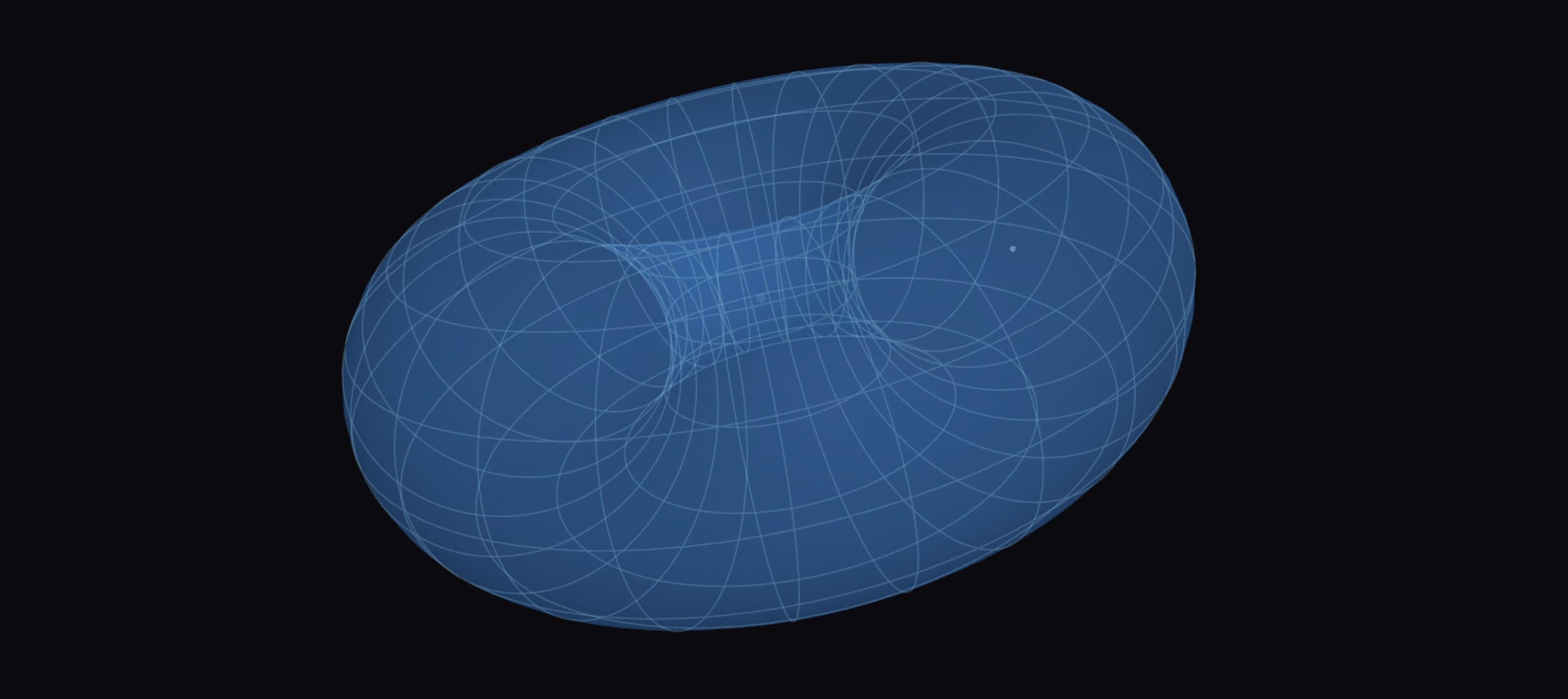
I wasn’t looking for it, but when it showed up, it made me look twice. Eventually, I published a math paper on it, and got to name a new shape!
It’s a theoretical math concept that could actually apply to life on Earth—a helpful formula for understanding how things grow and stack… from quantum particles to solar systems (if my physics theorems turn out to be correct)… without falling apart.
If you can understand how kids’ stacking bowls work, you can understand this. So stick with me and comment if you have any questions!

First Things First
A torus is a shape that looks like a pool donut. 🍩 🏖️
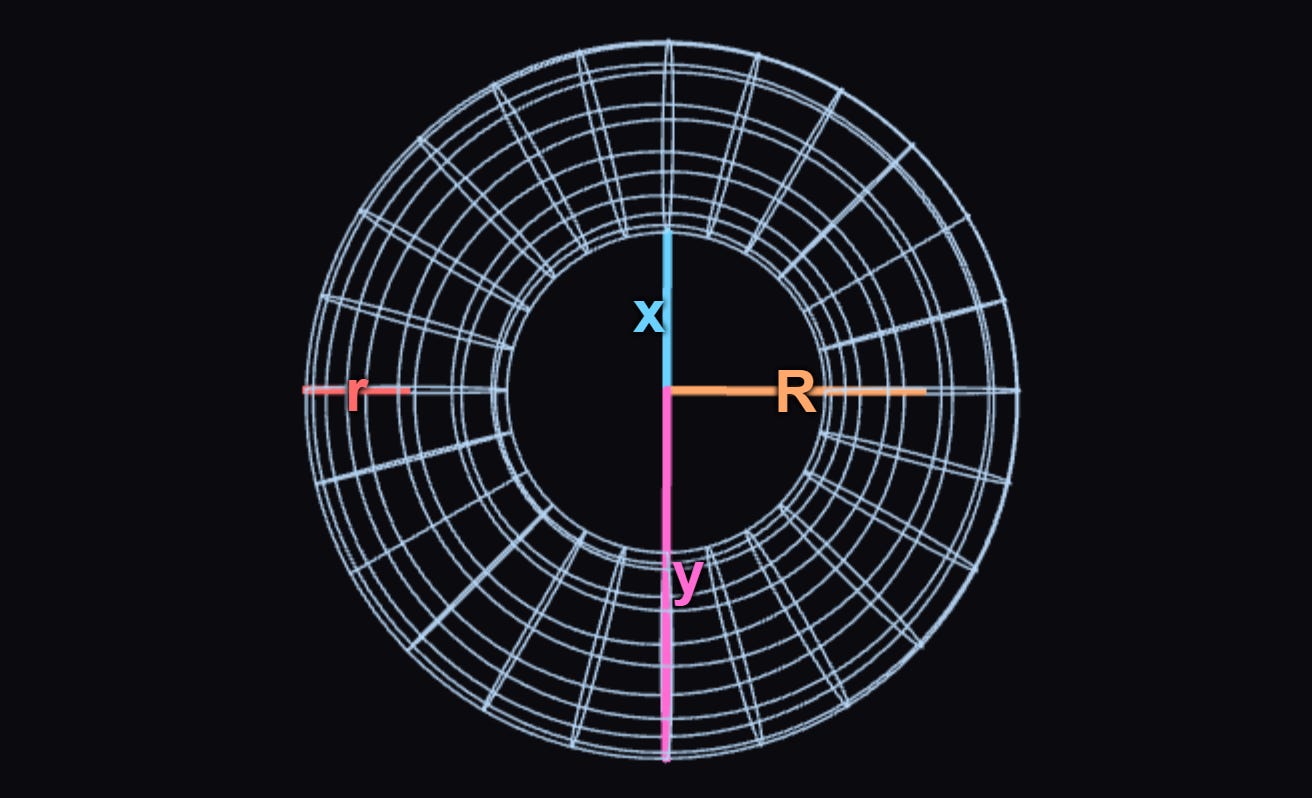
Every donut has four natural radii built into it (see image below):
Hole radius (x)
Tube radius (r)
Major spine radius (R)
Outer edge radius (y)
To further simplify it, those 4 things can be expressed using only two variables:
R and r.
The width of the donut (y) becomes R+r, and the inner hole (x) becomes R-r.
So, we don’t even need x and y anymore!
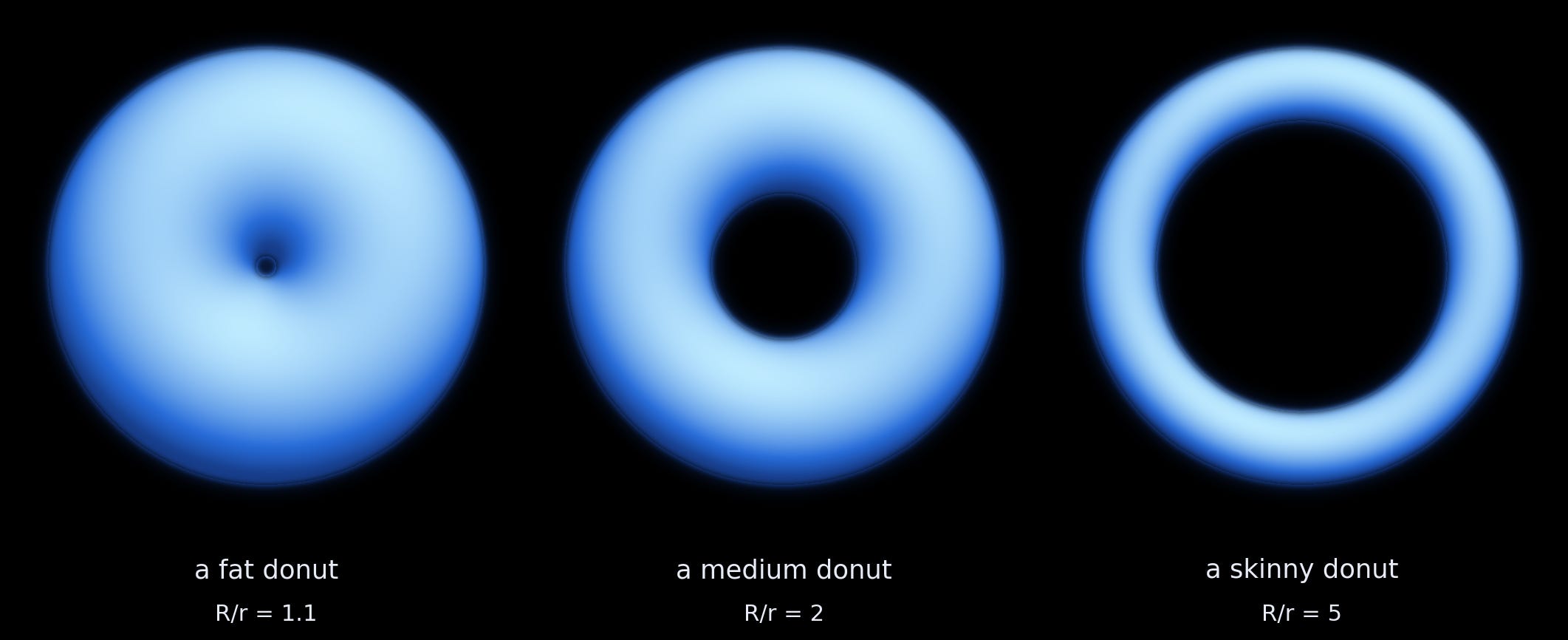
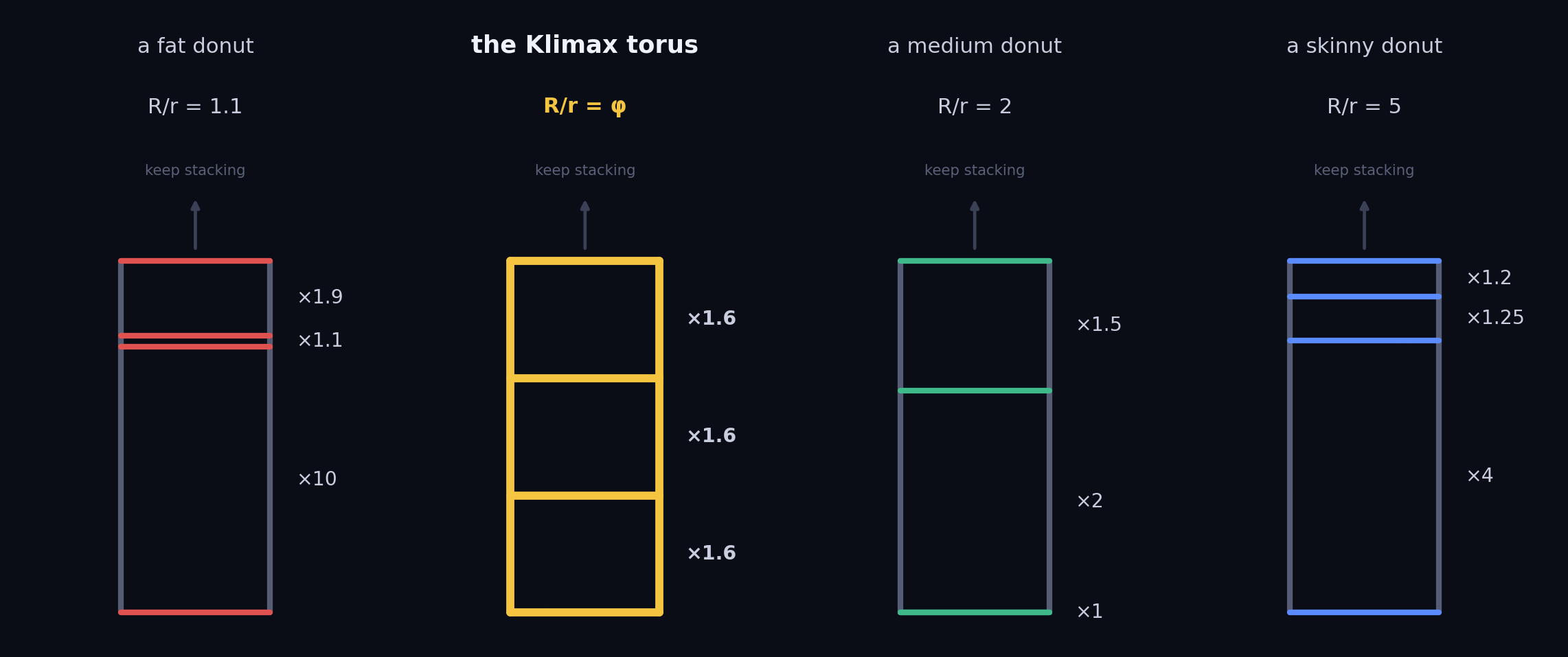
There can be many different shapes of donuts/tori (see some examples below) with varying R and r measurements. We can define these donuts exactly by their unique R/r ratio.
For example, for a donut with R=3 and r=2, its R/r=1.5.
The larger the ratio, the skinnier the donut.
Just like the donuts above, the Klimax torus is also uniquely defined by a specific R/r, and that R/r = phi (φ), which equals approximately 1.61803398874... and that number never ends, it runs on forever without repeating (it’s an “irrational number”).
When you choose φ as your R/r, the donut comes out looking like this:
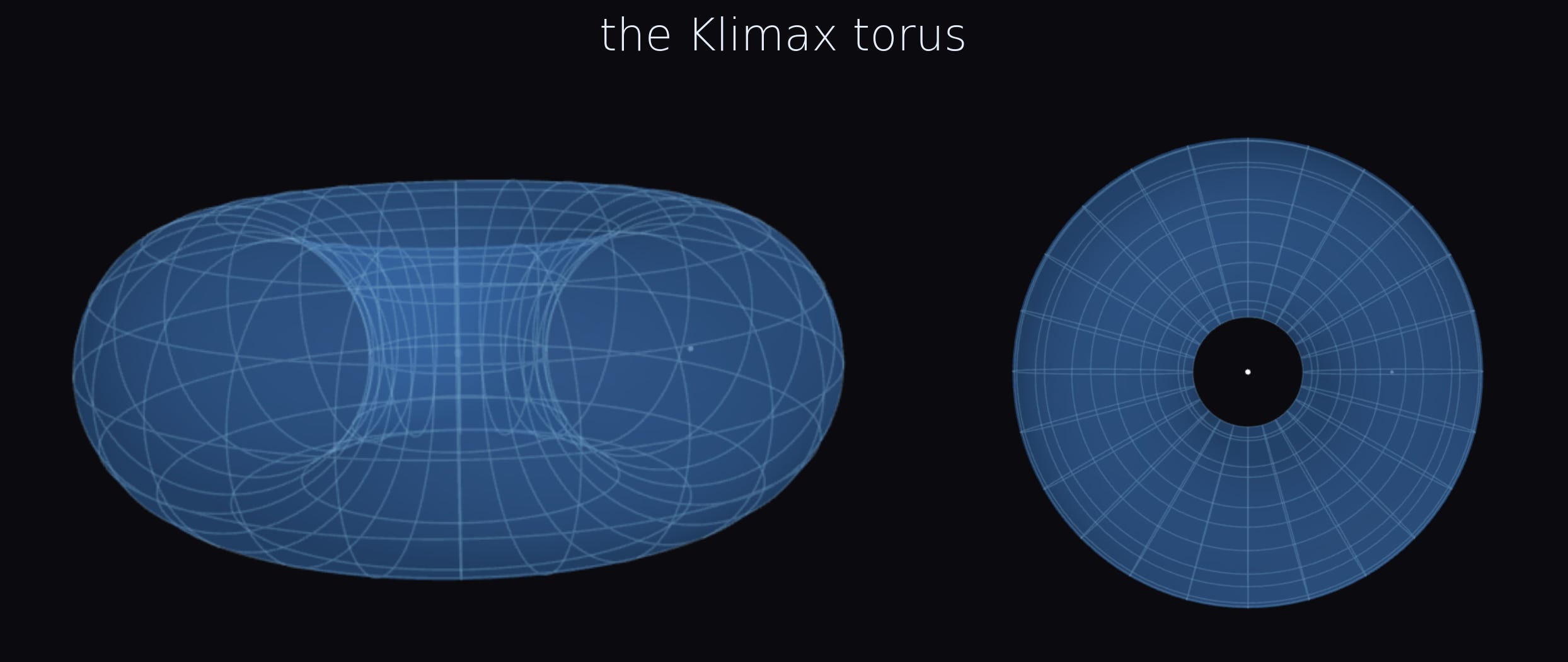
It’s just a regular old donut with specific measurements that make it always look like this shape (no matter the scale). I call it “the Klimax torus.”
Now that we understand what the Klimax torus is, let’s look at what makes it special.
The Ladder
If you line up a torus’s four radii measurements, they form a ladder. To build the ladder, you just line up the four sizes smallest to biggest.
No matter the shape or size of the donut, you’ll always get a ladder of some kind.
For example, using a donut with R/r = 1.3, the ladder comes out looking like this:
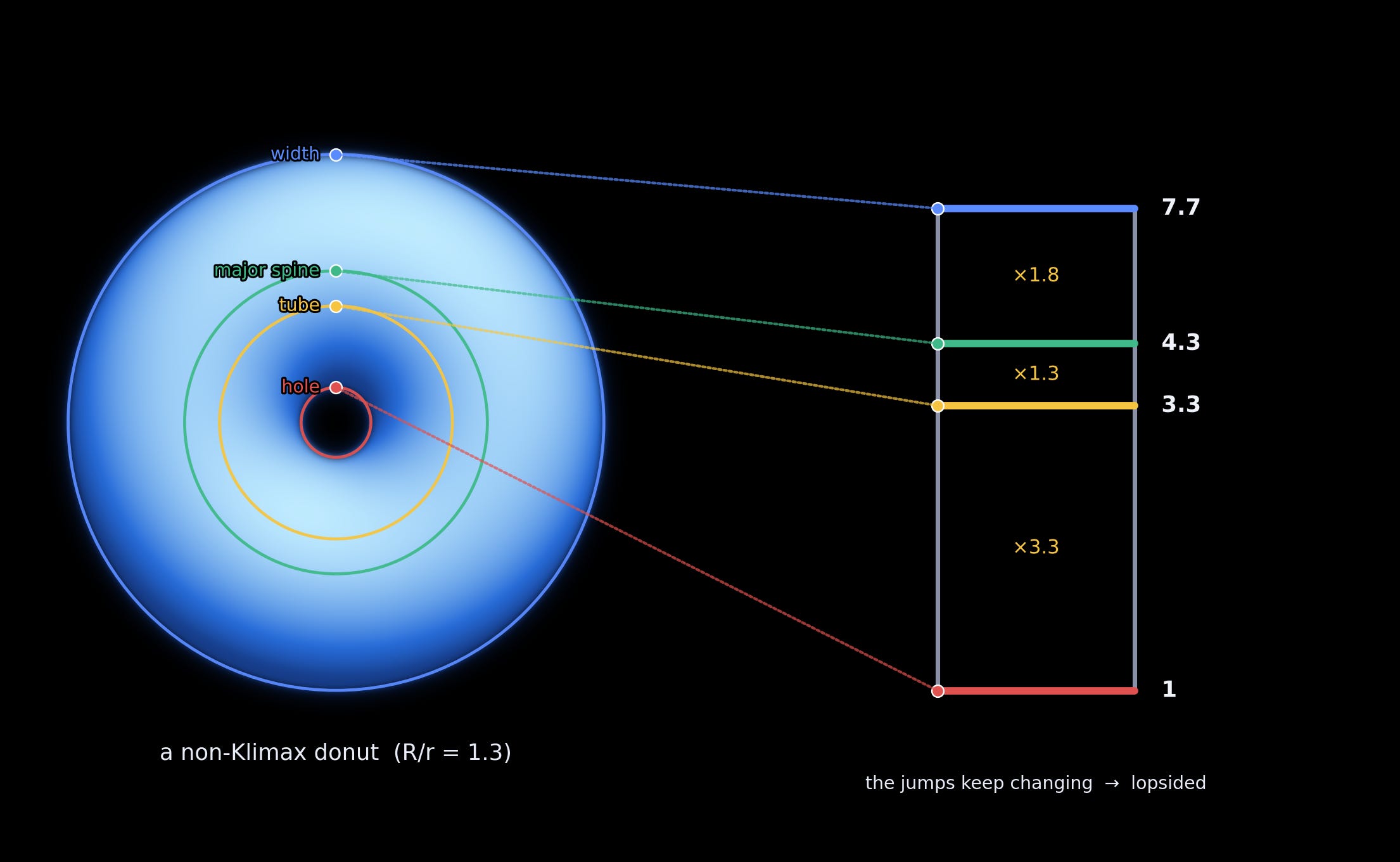
Each step up the ladder is some multiple away from the rung before it. The spacing between rungs is uneven, and for every donut you could pick, they always will be.
Except for one...
There is exactly one unique donut with an R/r that produces perfectly spaced ladder rungs as you nest them, no matter how far you nest it, in or out.
You guessed it…
It’s the Klimax torus. And the algebra proof in my paper guarantees that no second donut ever does this.
(Klimax = “ladder” in Greek)
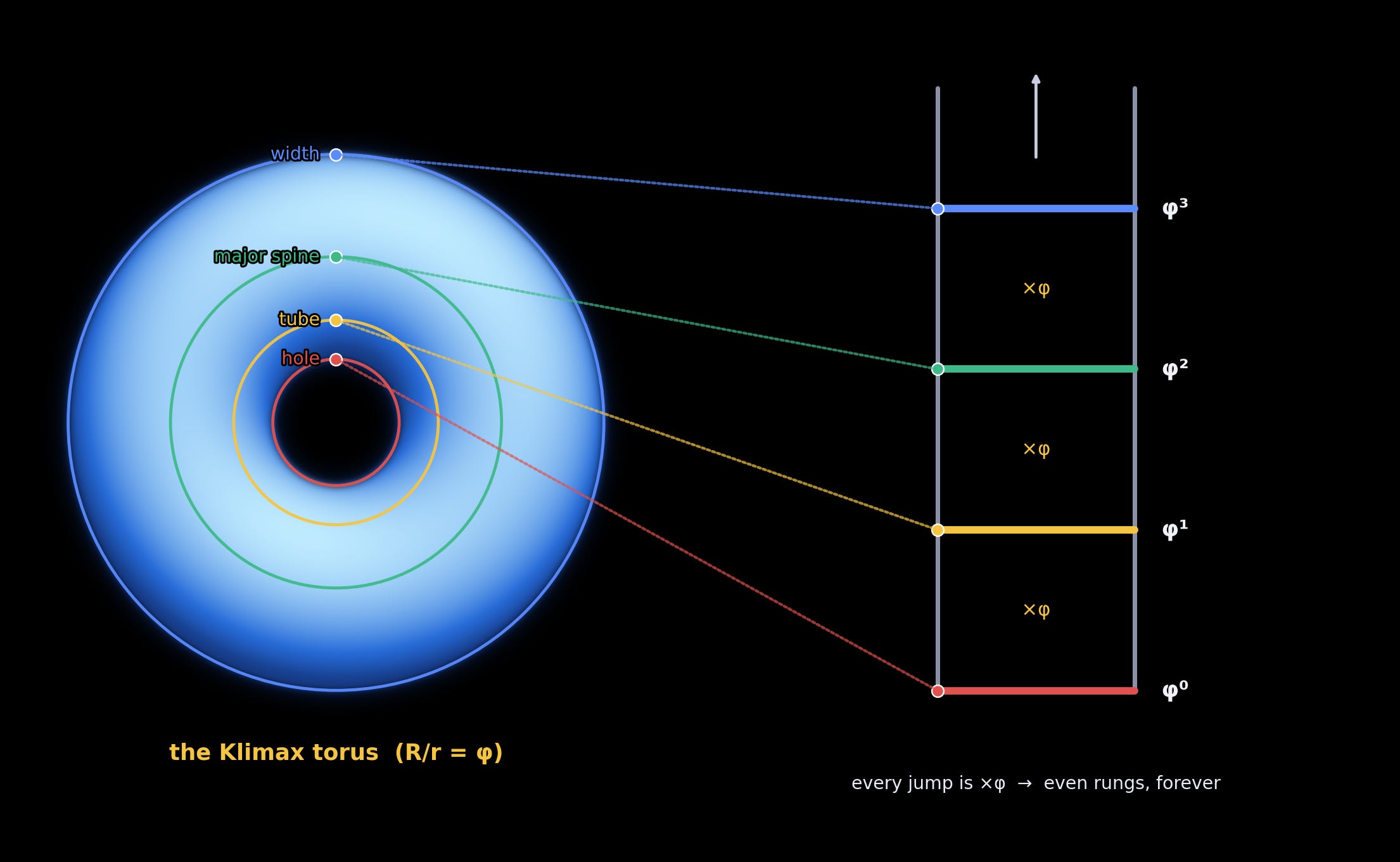
With the Klimax torus, something satisfying emerges when you nest them. Each rung is one phi-step away from the last one. And that means the next larger torus is exactly φ3 times bigger than the smaller one it wraps. Always.
The Numbers
If symbols and exponents aren't your thing, here's the whole takeaway: every rung is the same jump above the last. You multiply by phi each time, forever. That's it. Feel free to skip to the next section.
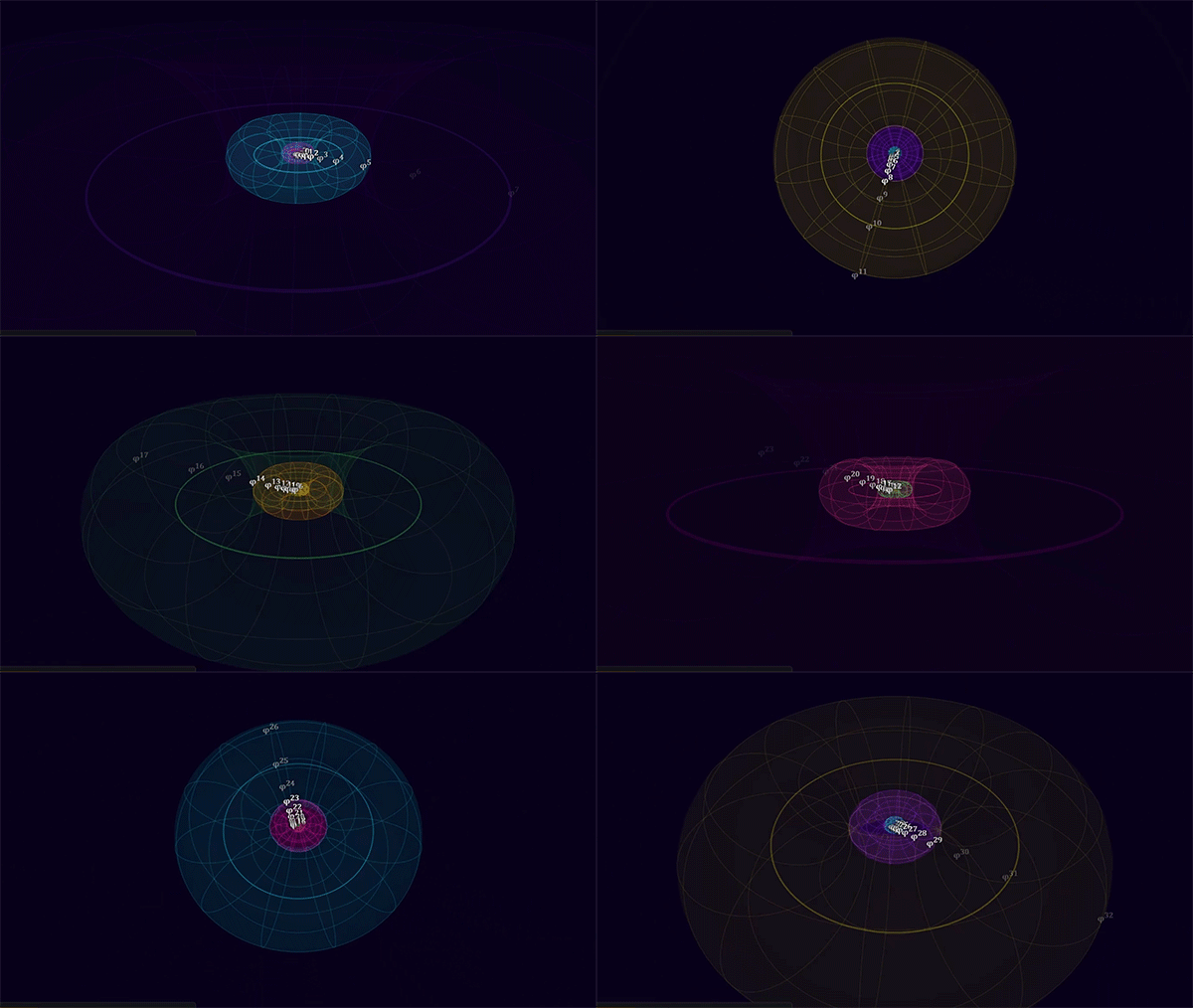
For the math curious: the actual progression of radii measurements on the Klimax torus goes like this as they nest (extending outward):
φ0 - hole radius
φ1 - tube radius
φ2 - major spine radius
φ3 - outer edge radius / hole radius of next larger torus…
φ4 - the pattern repeats on the next larger torus…
φ5
φ6
…. forever.
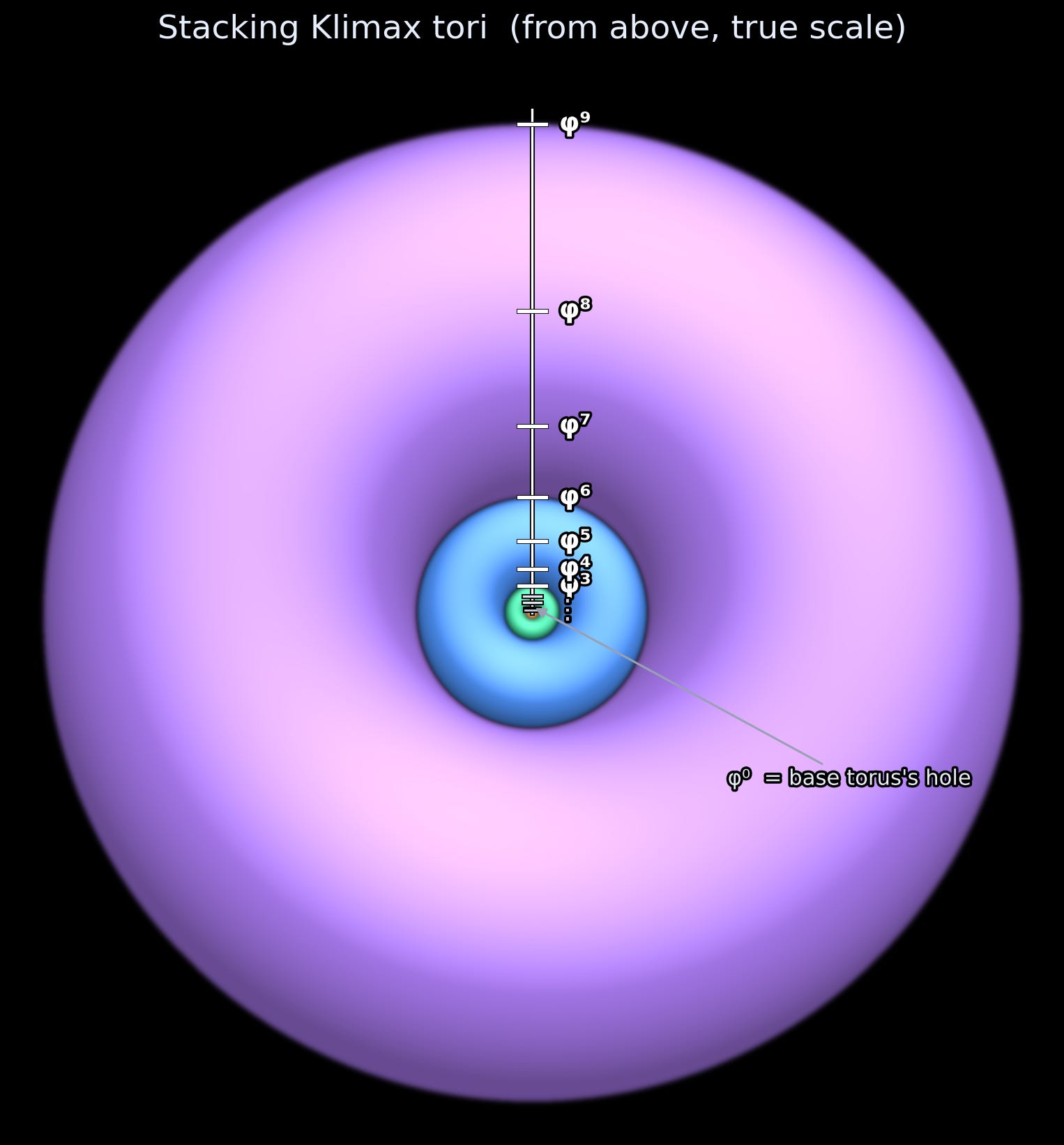
You can also extend this pattern in the negative direction, if you’d rather zoom in. Your phi exponents will just become negative. So zooming in past the original Klimax torus:
φ0 - outer edge radius of smaller torus / hole radius of larger torus…
φ-1 - major spine radius
φ-2 - tube radius
φ-3 - hole radius / outer edge radius of next smaller torus
… and so on.
The Grander Picture
So the connection to nature? It's not coincidence. Both the Klimax torus and phi-governed examples from the natural world come from the one thing φ does that no other number does… it stays self-similar at every scale. That's why it shows up anywhere something has to grow while staying the same shape — a seed head, a pinecone, or a stack of donuts.
It seems to be a favorite trick of nature's for building outward without falling apart.

What does this all mean? The big cosmic version, I don’t know yet…
I’m plugging it back into the atom model this whole thing fell out of, and into the rest of my physics work. I’m working on figuring out how far up and down the phi-governed ladder actually reaches.
If you have math friends who might enjoy this, please share! I’d love some feedback on this finding. Here’s the math paper link if you’d like to see the complete calculations.
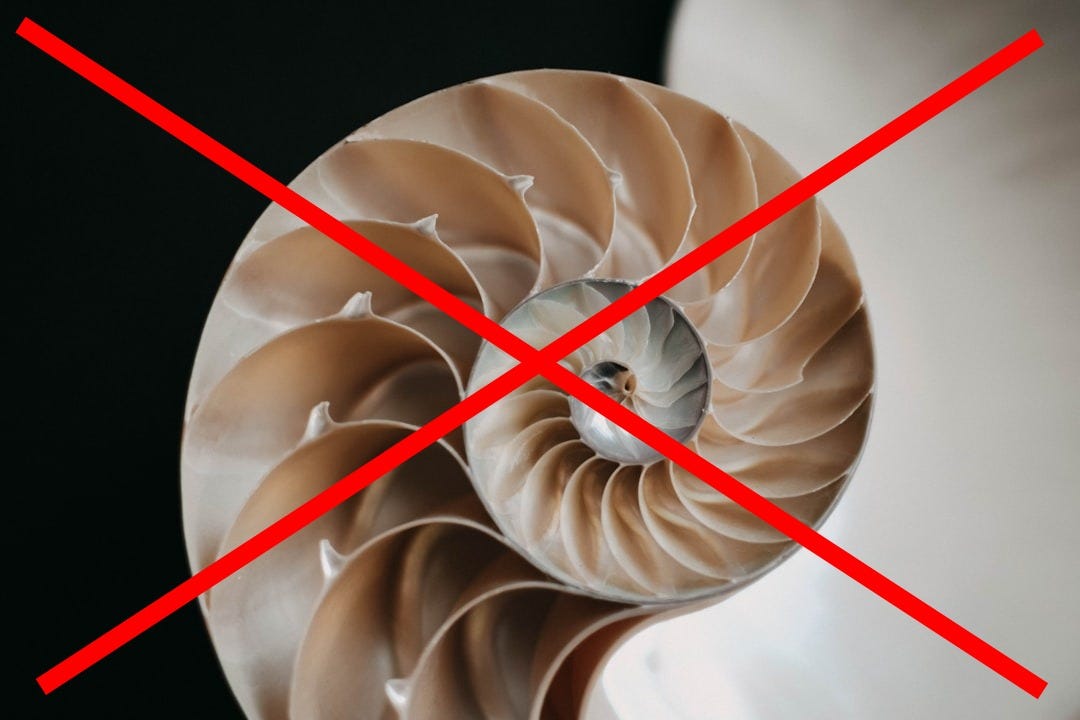
PS - the nautilus shell is often cited as a phi-based construction, but it’s actually logarithmic.

Gotta be honest, this was interesting but also totally above my head. Nature is amazing! Will share with math friends.
what an elegant number